Five paths is an answer. One path is a plan.
Turn What You Already Know Into a Service People Will Pay For
Your assessment ranked the five income paths your experience points to. Skills2Salary is how you choose one, build the offer, price it, and find the first person who will pay for it.
100% Online • 6 Courses • Practical Worksheets • Lifetime Access
You do not need another degree, a large audience, or a completely new career. You need a clear way to turn the experience you already have into something the market can understand and buy.
You Have Spent Decades Building Valuable Skills.
Now Learn How to Sell Them.
You have solved problems, managed responsibilities, trained people, improved processes, handled customers, organized operations, led projects, and made decisions that required experience and judgment.
But when you have done something for years, it can be difficult to recognize its value.
What feels ordinary to you may be exactly what another person or organization needs help doing.
The problem is not that you have nothing valuable to offer.
The problem is that your experience may still be trapped inside job titles, résumés, and responsibilities that were defined by an employer.
Skills2Salary helps you pull that experience apart, identify the strongest pieces, connect them to real customer problems, and turn them into a focused paid offer.
By the end of the program, you will have worked toward answering four essential questions:
- What valuable problem can I solve?
- Who needs that problem solved?
- Who needs that problem solved?
- How will I find and serve my first customers?
You are not starting from nothing.
You are starting from experience.
Your Experience May Be Valuable—But Value
That Cannot Be Explained Is Difficult to Sell
Many experienced professionals reach a point where they want more control over how they work and earn.
They may be preparing for retirement, recovering from a layoff, facing fewer advancement opportunities, looking for additional income, or simply tired of depending entirely on an employer.
They know they have useful experience, but they struggle to turn it into an independent source of income.
They ask:
Which of my abilities have the greatest market value?
Should I consult, coach, train, freelance, or create a service?
How do I choose one direction without wasting time and money?
How do I describe what I do without sounding vague?
What should I charge?
Where will I find customers?
Why would someone choose me?
Without clear answers, many capable people remain stuck. They collect business ideas, buy unrelated courses, create websites before validating demand, or try to offer too many services at once.
Skills2Salary gives you a structured way to move from “I have years of experience” to “This is the problem I solve, this is who I help, and this is what I offer.”
From Unclear Experience to a Focused, Sellable Offer
Before Skills2Salary
- Your best skills may feel ordinary because you have used them for years.
- Your experience may be described through job titles instead of customer outcomes.
- You may have several business ideas but no reliable way to choose one.
- You may not know who would pay for your knowledge.
- You may be unsure what to offer, what to charge, or how to find customers.
After Completing the Process
- A clear inventory of your most valuable transferable skills
- Evidence connecting those skills to results you have produced
- A defined customer problem worth investigating
- A selected income path that fits your experience and capacity
- A focused paid offer with clear boundaries and deliverables
- A starting price based on scope and value
- A professional one-page offer presentation
- A targeted prospect list
- Outreach and discovery-conversation scripts
- A customer onboarding and service-delivery process
- A practical plan for building income without overwhelming yourself
The Skills2Salary Framework
Six Clear Stages From Experience to Independent Income
These six courses are the foundation. They take you from five possible paths to one chosen path with a tested offer and a first customer. Once you know which path is yours, there is a dedicated course that teaches that path in depth.
Understand
1
Identify the skills, knowledge, judgment, and problem-solving abilities you have built throughout your career. Separate what you know from the job titles under which you learned it.
What am I unusually good at, and what evidence supports it?
Validate
2
Investigate whether real people or organizations experience the problem you believe you can solve. Learn what they call the problem, how they currently handle it, and whether it is important enough to address.
Does a real market need this help?
Choose
3
Compare your abilities, customer needs, available time, preferred work style, and income goals. Then select one practical starting path.
What is the best way for me to deliver this value?
Create
4
Turn your chosen direction into a specific offer with a defined customer, outcome, scope, delivery method, and starting price.
What exactly am I selling?
Sell
5
Identify appropriate prospects, begin professional conversations, understand their needs, present your offer, and establish clear next steps.
How will I find and win my first customers?
Sustain
6
Build repeatable systems for onboarding, delivery, customer feedback, workload management, and future growth.
How can I deliver consistently without creating another exhausting job?
Nine income paths. Nine courses.
Your assessment ranked five of these for you. The foundation program narrows those five to one. Then each path has its own course, built to teach that path in depth.
Done-for-You Services
A specific process a client needs run properly, that you run for them.
Training and Workshops
Teaching individuals, teams, organisations, or community groups.
Fractional roles
Part-time leadership or expertise, without becoming a full-time employee.
Freelance or Contract Services
Defined professional work, delivered on a contract, for a fee you set.
Advisory Work
Professional judgment, recommendations, and strategic guidance.
Digital Products
Turn repeatable knowledge into templates, guides, systems, workbooks.
Coaching or Mentoring
Helping people improve performance, make decisions, or navigate a process.
Speaking and facilitation
Leading discussions, planning sessions, conferences, and educational events.
Courses and Memberships
Teaching a defined result through structured learning and community support.
Start with the foundation. It is what tells you which of these nine is actually yours.
What Turning Experience Into Income Can
Look Like
- An experienced operations manager could help small companies document workflows, reduce confusion, and create standard operating procedures.
- A former supervisor could provide frontline leadership training for newly promoted managers.
- An experienced administrative professional could build organization and scheduling systems for small-business owners.
- A retired sales professional could help local companies improve customer follow-up and sales conversations.
- A former human-resources professional could help small employers improve onboarding and employee documentation within the limits of their qualifications.
- An experienced educator could develop workshops, tutoring services, training materials, or mentoring programs.
- A project manager could help organizations plan, organize, and complete projects that lack internal leadership.
These examples are illustrations, not assigned careers. Skills2Salary helps you evaluate your own experience and determine which direction deserves further testing.
What Skills2Salary Helps You Do
Recognize the Value Hidden in Your Work History
Identify the abilities you may overlook because they have become second nature.
Test Demand Before
Building
Speak with potential customers and examine the market before investing heavily in a website, branding, advertising, or technology.
Find the Right Prospects
Focus on people and organizations with a relevant problem instead of trying to market to everyone.
Separate Your Skills From Your Job Title
Understand how your experience can remain useful even when you leave a particular employer or industry.
Create an Offer People Can Understand
Define the customer, problem, outcome, deliverables, boundaries, and delivery process.
Start Professional Sales Conversations
Use a clear process for outreach, discovery, presenting the offer, and establishing next steps.
Choose One Direction With Confidence
Compare possible income paths using clear criteria instead of jumping from idea to idea.
Set a Defensible Starting Price
Use the scope, effort, customer value, expenses, and market context to establish a price you can explain.
Build Around Your Capacity
Create an income path that accounts for your available time, energy, health, responsibilities, and preferred workload.
Everything You Need to Move From “What Could I Do?” to “Here
Is What I Offer.”
Six courses, released in order. This is the foundation. It ends with one chosen path, a written offer, a price, and a first customer.
Course 1
What Your Assessment Means
Identify your strongest transferable skills and connect them to evidence from your actual work history.

You will learn how to:
- Interpret your assessment results
- Identify skills you may be undervaluing
- Separate transferable abilities from job-specific duties
- Document problems you have solved and results you have produced
- Combine related skills into possible income directions
- Choose an initial direction to investigate
You finish with: Your Transferable Skills Direction Portfolio
Course 2
Validate and Position Your Experience
Determine whether your initial direction connects to a real customer problem before investing substantial time or money.
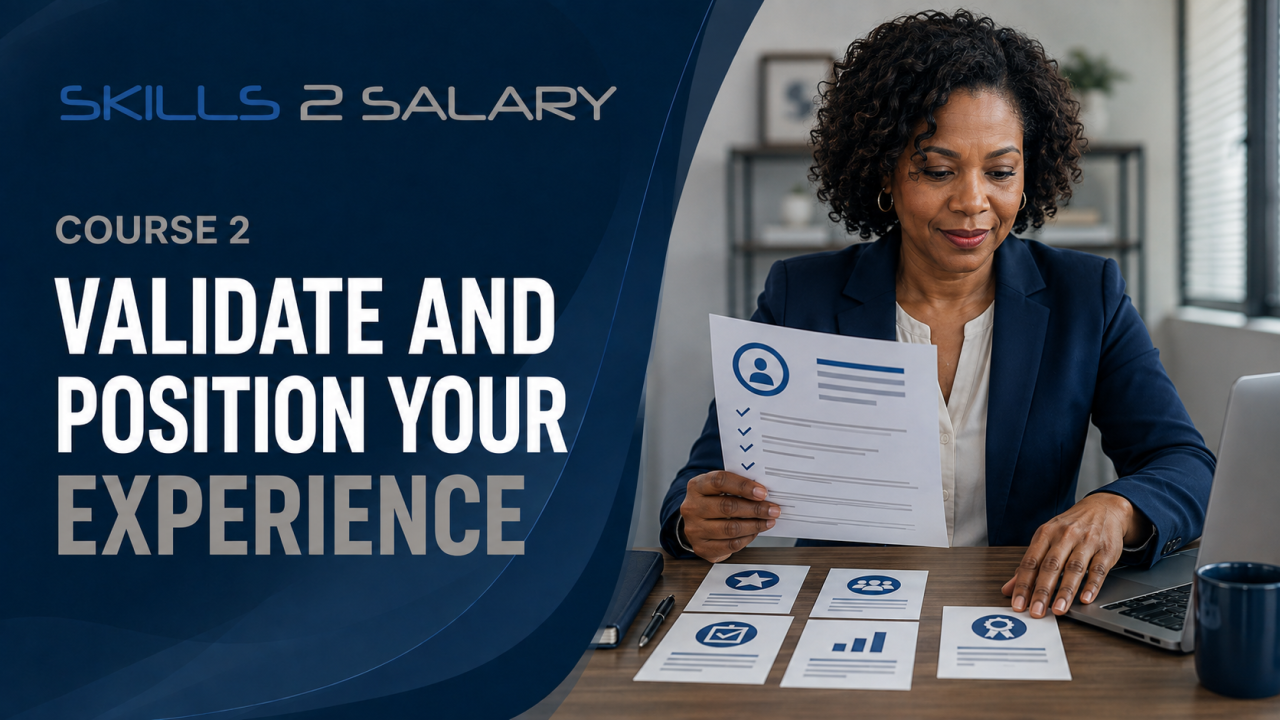
You will learn how to:
- Turn assumptions into questions that can be tested
- Research existing services and competing solutions
- Identify potential customers
- Conduct structured customer-discovery conversations
- Recognize evidence of genuine demand
- Use the customer’s language to describe the problem
- Continue, adjust, or reject an idea based on what you learn
You finish with: Your Validation Evidence File
Course 3
Choose Your Income Path
Compare nine ways to turn your experience into income and select the best starting model for you.

You will learn how to:
- Understand the nine income paths
- Compare service, advisory, training, and product-based models
- Evaluate your time, energy, financial needs, and personal boundaries
- Match your preferred work style to a delivery method
- Identify the tradeoffs of each option
- Choose one primary path instead of pursuing everything at once
You finish with: Your Income Path Decision Portfolio
Course 4
Create, Price, and Present Your Offer
Turn your chosen direction into a specific service or product that a potential customer can understand and evaluate.
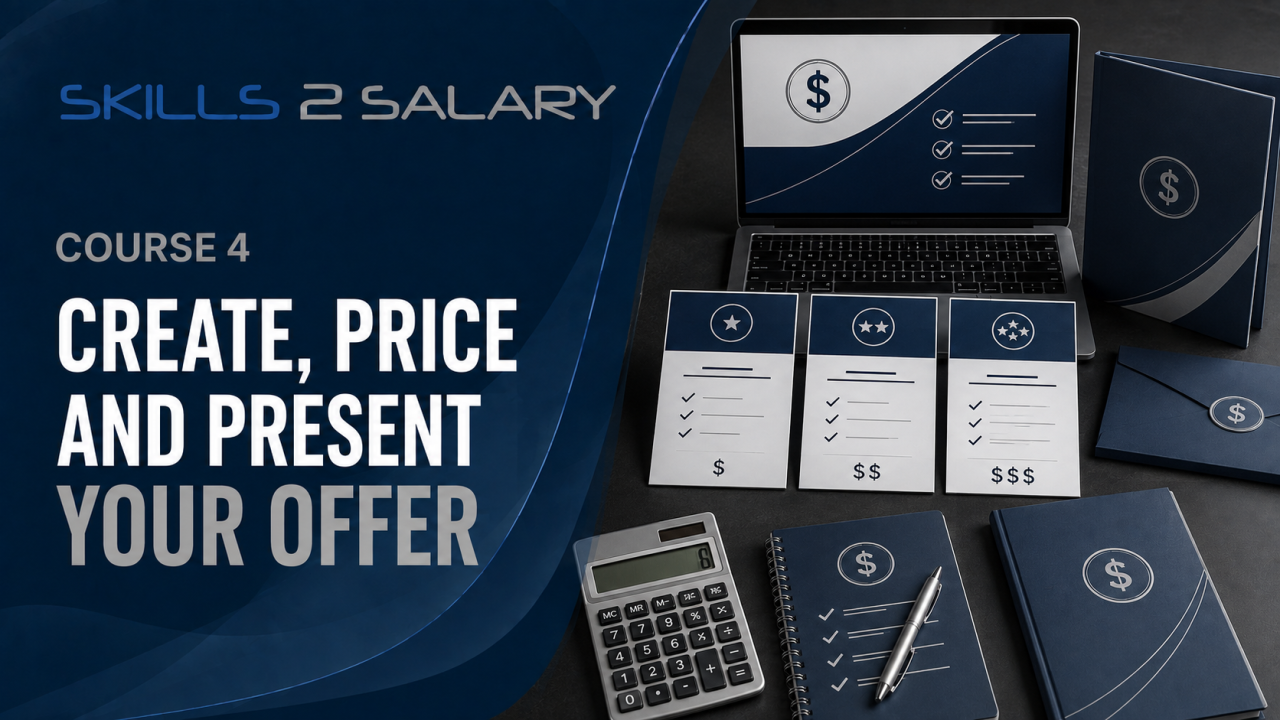
You will learn how to:
- Define the problem your offer addresses
- Describe the customer you intend to serve
- Establish the outcome and deliverables
- Set limits on what is and is not included
- Choose an appropriate delivery method
- Develop a starting price
- Organize your offer into a one-page presentation
- Test the offer before expanding it
You finish with: Your Minimum Viable Paid Offer Package
Course 5
Find and Win Your First Customers
Build a focused process for identifying prospects, starting conversations, presenting your offer, and onboarding customers.
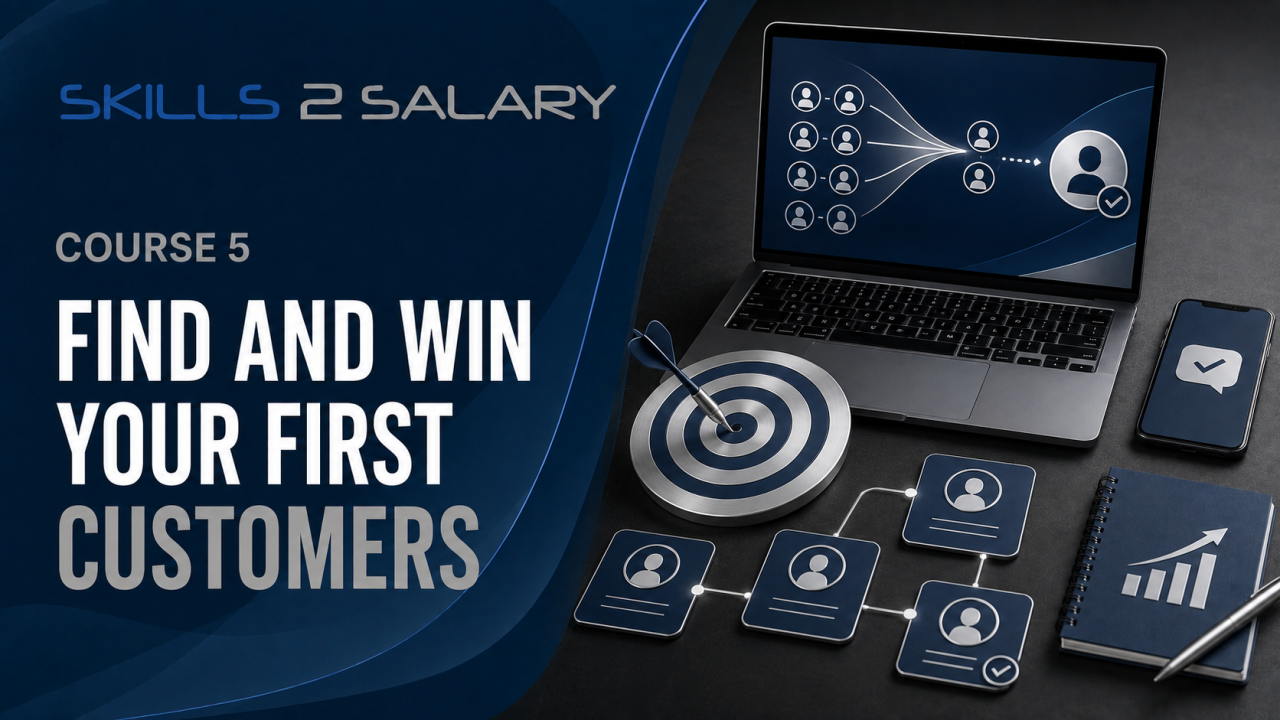
You will learn how to:
- Define your first-customer strategy
- Identify people and organizations likely to need your help
- Build a focused prospect list
- Write professional outreach messages
- Conduct discovery conversations
- Recognize whether a prospect is a good fit
- Present your offer clearly
- Establish expectations, payment, and next steps
You finish with: Your First-Customer Action Kit
Course 6
Build Sustainable Income and Systems
Create a reliable way to deliver your offer, protect your capacity, learn from customers, and make thoughtful decisions about growth.
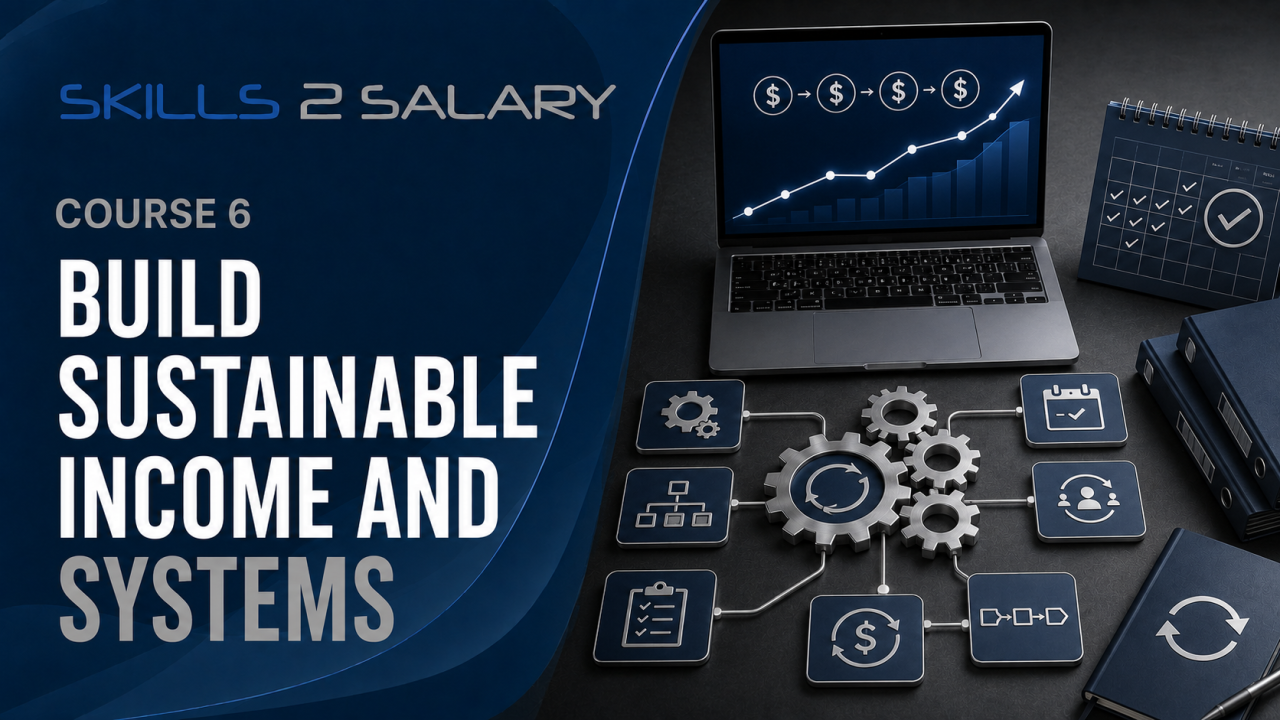
You will learn how to:
- Create a repeatable onboarding process
- Build delivery checklists and workflows
- Set customer communication expectations
- Collect useful feedback
- Document customer outcomes when appropriate
- Improve your offer based on experience
- Protect your time and personal boundaries
- Evaluate recurring, group, or leveraged income options
- Review your direction without constantly starting over
You finish with: Your Sustainable Practice Playbook

MEET YOUR INSTRUCTOR
Terre Polite — 65, and still adding
I'm Terre Polite. I'm 65. My career has been in the counseling field — addiction counseling, vocational rehabilitation, community mental health, juvenile justice. I've owned my own businesses. I've traveled the world. I played by the rules, same as you. Across all of it I did the same thing: sat across from somebody the world had already made up its mind about, and found the part of them that was worth hiring. Placements for everyone from people with disabilities to people coming home from prison — the hardest placements there are. I've also taught the skills themselves. Résumé classes, life skills, communication, problem solving, teamwork, emotional intelligence. The forty skills in the assessment aren't a list I found somewhere. They're what I spent years teaching people to recognize in themselves. I started in 1982, as an E-5 in the 11th Armored Cavalry Regiment. Everything since got added on top of it. Nothing got taken away.
Instructional Designer • Counselor • Army Veteran • Educator Promoted to Sergeant (E-5), 1982

You Will Not Finish With a Notebook Full of Ideas
You will work toward completing six practical business-building assets:
1
Transferable Skills Direction Portfolio
A documented record of your strongest skills, relevant accomplishments, supporting evidence, and initial income direction.
4
Minimum Viable Paid Offer Package
Your customer definition, problem statement, outcome, deliverables, scope, delivery process, and starting price.
2
Validation Evidence File
Your market research, customer observations, discovery notes, buyer language, and conclusions about demand.
5
First-Customer Action Kit
Your prospect list, outreach messages, discovery questions, offer-presentation process, and onboarding steps.
3
Income Path Decision Portfolio
A structured comparison of the nine paths and a documented decision about your best starting model.
6
Sustainable Practice Playbook
Your service-delivery workflow, customer feedback process, workload boundaries, and review schedule.
Your Complete Skills-to-Income
Implementation System
Enrollment includes:
- Six courses, released in order. Once a course opens it stays open.
- Weekly live session with Terre.
- Bring your work, ask questions, get unstuck.
- Self-paced between sessions. No deadline to miss.
- Lifetime access, including future updates
- Access to the path courses when you are ready for one
- 30 modules
- 90 lessons
- 30 editable worksheets
- Six capstone projects, one per course
- Six finished deliverables you keep
The objective is not simply to teach you about independent income.
The objective is to help you build the foundation for pursuing it.
Skills2Salary Is Built for Experienced People Who Are Ready to Use What They Know
This program may be right for you if:
- You have years of workplace or professional experience
- You know you are capable but struggle to explain what you could sell
- You want income that is less dependent on a traditional employer
- You are approaching retirement but do not want your useful experience to disappear
- You have been displaced, downsized, overlooked, or forced to reconsider your career
- You want to consult, freelance, coach, train, mentor, or provide a specialized service
- You have several ideas but need a process for choosing one
- You want to test demand before spending heavily
- You do not want to become an influencer or build your life around social media
- You prefer a serious, practical process over hype
- You are willing to speak with potential customers and apply what you learn
Skills2Salary Is Not a Shortcut or an Income Guarantee
This program is not designed for people seeking:
- Guaranteed customers or guaranteed income
- A done-for-you business
- A passive-income promise
- An overnight financial solution
- A business opportunity requiring no customer contact
- A professional license or academic credential
- A substitute for legal, financial, tax, or licensing advice
Skills2Salary provides education, structure, exercises, and implementation tools. Your results will depend on your experience, selected market, customer demand, effort, decisions, and execution.
You Do Not Need to Become Someone Else to Build Something of Your Own
“I don’t know what I could sell.”
That is why the program begins with your experience, accomplishments, and transferable skills—not with a predetermined business idea.
“I have never owned a business.”
Skills2Salary starts before the business exists. It helps you decide what to offer, who may need it, and how to test the idea.
“I am not a salesperson.”
You do not need to pressure people. The sales process focuses on identifying relevant prospects, asking useful questions, understanding problems, and determining whether your offer fits.
“I am not technically advanced.”
The core work is based on thinking, research, conversations, decisions, and practical documents. Technology supports the process; it is not the foundation of your value.
“I don’t have an audience.”
The program does not require you to become an online personality. It teaches you to identify specific prospects who may already have the problem you can solve.
“My experience seems too ordinary.”
Skills often feel ordinary to the person who has practiced them for years. The program helps you examine where your knowledge produces value for someone who lacks it.
“I have too many possible directions.”
You will compare the options and use clear criteria to choose one practical starting path.
“What if my idea is not viable?”
That is why validation happens before extensive building. Discovering weak demand early gives you an opportunity to adjust without wasting greater time and money.
“I don’t want to create another exhausting job.”
The final stage helps you establish workload boundaries, delivery systems, and a model that reflects your actual capacity.
Start With What You Already Know
Your Assessment is the First input, not a preview.
Forty skills across ten categories. Your answers produced three things: where your experience is concentrated, which skills you rated highest, and the five income paths those combinations point to.
Course 1 opens by taking that result apart. Not to re-score you — to show you what your own numbers mean, which of your strongest skills carry the most weight in a market, and where the gap sits between what you can do and what somebody will pay for.
If you have not taken it yet, take it first. It is free, it takes ten minutes, and Course 1 assumes you arrive holding your results.
Every tier begins with the same principle: you already have experience. The next step is learning how to recognize, explain, validate, and apply it.
Tier 1
Experience Inventory Needs More Exploration
Uncover accomplishments, responsibilities, and abilities you may have overlooked.
Tier 2
Transferable Skills Ready to Be Defined
Turn broad experience into clearly defined skills supported by examples and evidence.
Tier 3
Strong Experience With Income Potential
Narrow several possible strengths into a focused direction that can be tested.
Tier 4
Extensive Transferable Expertise
Refine established strengths into a specific offer and delivery model.
You Will Not Finish With a Notebook Full of Ideas
You will work toward completing six practical business-building assets:
It Starts With You
You are not handed a fashionable business model and told to force yourself into it. You begin with the experience, strengths, limits, and interests you already have.
It Forces Focus
Instead of chasing several directions at once, you select one realistic starting path.
One stage at a time, at your own speed.
The courses open in order, because choosing a path before you have validated it is the most common way this goes wrong. Once one is open it stays open, and you work through it on your schedule.
It Separates Skills From Job Titles
Your value does not disappear when a job ends. The program helps you identify capabilities that can transfer across employers, industries, and income models.
It Produces a Clear Offer
You define what you do, who it is for, what the customer receives, how it is delivered, and what it costs.
It Tests Before It Builds
You investigate the customer problem and available market before investing heavily in branding, technology, or promotion.
It Includes Customer Acquisition
The process continues beyond identifying an idea. You develop a prospect list, outreach messages, discovery questions, and onboarding steps.
The Organization Behind Skills2Salary
Helping Experienced Professionals Turn Knowledge Into Practical Opportunity
ATLV Solutions develops educational programs and practical implementation systems for people navigating career change, independent work, and new income opportunities.
Skills2Salary was created around a straightforward belief:
Experienced people should not have to discard decades of knowledge simply because a job ends, an industry changes, or retirement approaches.
The program helps participants examine what they know, connect it to problems people may need solved, and organize that knowledge into a clear offer.
Your Enrollment Includes
- All six Skills2Salary courses
- Weekly live sessions with Terre
- Thirty implementation worksheets
- Six completed business-building portfolios
- The Sellable Skills Assessment
- Offer-development and pricing tools
- Customer-research and discovery guides
- Prospect and outreach tools
- Customer-onboarding resources
- Delivery and sustainability systems
- Lifetime curriculum access
- Access to the path courses when you're ready
Regular Price
$97/monthly
Enroll Today
$47/monthly
That's the founding rate.
Skills2Salary goes to $97 a month for people who join later.
For 6-Months
You Do Not Need to Become Someone Else to Build Something of Your Own
“I don’t know what I could sell.”
That is why the program begins with your experience, accomplishments, and transferable skills—not with a predetermined business idea.
“I have never owned a business.”
Skills2Salary starts before the business exists. It helps you decide what to offer, who may need it, and how to test the idea.
“I am not a salesperson.”
You do not need to pressure people. The sales process focuses on identifying relevant prospects, asking useful questions, understanding problems, and determining whether your offer fits.
“I am not technically advanced.”
The core work is based on thinking, research, conversations, decisions, and practical documents. Technology supports the process; it is not the foundation of your value.
“I don’t have an audience.”
The program does not require you to become an online personality. It teaches you to identify specific prospects who may already have the problem you can solve.
“My experience seems too ordinary.”
Skills often feel ordinary to the person who has practiced them for years. The program helps you examine where your knowledge produces value for someone who lacks it.
“I have too many possible directions.”
You will compare the options and use clear criteria to choose one practical starting path.
“What if my idea is not viable?”
That is why validation happens before extensive building. Discovering weak demand early gives you an opportunity to adjust without wasting greater time and money.
“I don’t want to create another exhausting job.”
The final stage helps you establish workload boundaries, delivery systems, and a model that reflects your actual capacity.
Your Next Income Is Probably Hiding in Work You Have Already Done
The assessment found five places it might be. This is how you find out which one, and what to do about it. You are not starting over. You are adding.
You bring the experience.
Skills2Salary helps you turn it into a focused path forward.
Earnings Disclaimer
Skills2Salary is an educational program developed by ATLV Solutions. It provides frameworks, exercises, templates, and implementation tools for evaluating and developing possible independent income opportunities.
Skills2Salary does not guarantee business success, customer acquisition, employment, or any specific level of income. Results vary based on the participant’s experience, selected market, customer demand, effort, pricing, decisions, economic conditions, and execution.
The program does not provide legal, financial, tax, accounting, licensing, or professional regulatory advice.